


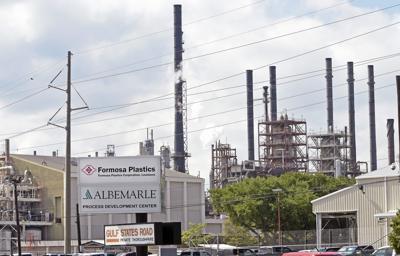
A sign on Scenic Highway indicates the Formosa Plastics plant Monday April 23, 2018, in Baton Rouge, La.
ADVOCATE STAFF PHOTOState regulators and Formosa Plastics are proposing an $80,000 penalty to settle hundreds of alleged violations involving toxic chemicals and other pollutants at its Baton Rouge complex that in some cases date back 25 years.
The proposed settlement comes with the state Department of Environmental Quality under scrutiny from environmental groups for what they say is the agency's slow enforcement pace and small penalties that fail to deter poor operations and maintenance from multi-billion-dollar companies.
Many of the alleged air violations revolved around emissions of vinyl chloride, a highly flammable and potent human carcinogen. It is used to make polyvinyl chloride, or PVC, the common household, automotive and construction plastic.
Under the deal, Formosa would pay $45,000 to DEQ and another $35,000 over five years to the Baton Rouge Clean Air Coalition. The group meets at LSU and allows industry, government, academic and nonprofit officials to work on improving air quality.
Formosa also would not admit to any of the alleged violations detailed in five penalty notices issued between 2009 and 2021.
The most recent enforcement actions from 2021 were tied up in an in-house DEQ resolution process for a few years, agency records show. But the others, including the oldest violations, sat idle for years.
DEQ declined to comment on the pending settlement. Formosa didn't respond to a request for comment.
Jen Duggan, executive director of the Environmental Integrity Project advocacy group, called the settlement "too little and too late."
In September, her group and another based in the Lake Charles region, Micah 6:8 Mission, released a report showing DEQ had taken action in the heavily industrialized Lake Charles area more than five years after some incidents occurred. The report said delays had endangered the state's ability to pursue enforcement in some cases because incidents were so old and past legal deadlines.
The groups, which also sent DEQ a letter about its findings, looked at 78 enforcement actions between 2021 and 2026. Three out of five formal air enforcement actions came more than five years after the earliest cited violation.
DEQ has defended the agency's handling of incidents in Lake Charles, noting they were associated with some of the state's largest facilities and involved complicated regulatory matters. Agency officials also argued the groups didn't look at the rest of the state nor at DEQ's track record with the entire sweep of its responsibilities.
Unreasonable delays?
In Formosa's case, the alleged violations go back as far as 2001.
Some of the oldest alleged violations involve two units making vinyl chloride monomer and caustic chlorine that were shut in the mid-2000s through company modernizations, air permit applications show. The VCM unit was disassembled nearly 20 years ago and shipped off by a company that bought it, agency records show.
A sign on Scenic Higway indicates the Formosa Plastics plant Monday April 23, 2018, in Baton Rouge, La.
ADVOCATE STAFF PHOTO"The fact that the state is only now addressing serious pollution violations first reported 25 years ago highlights a chronic problem of unreasonable delays in enforcement that we highlighted in a letter we sent to LDEQ back on September 23," said Duggan, the EIP official.
She called the penalty "just a tap on the wrist for the release of dangerous pollutants corporation with billions of dollars in revenues."
Formosa is located inside a heavily industrialized zone along the Mississippi River between the state Capitol and the old Mississippi bridge at U.S. Highway 190, just north of ExxonMobil's Baton Rouge refinery and chemical complex.
The largest single accidental vinyl chloride monomer release at Formosa covered occurred in June 2003, when more than four tons of the carcinogen escaped in four minutes. At the time, the brief release amounted to about 15% of maximum emissions allowed from the plant's PVC unit for a year, permits show.
In a 2007 report, the U.S. Chemical Safety Board cited that Baton Rouge incident in an investigation of a separate deadly explosion and fire from a vinyl chloride monomer release at a Formosa PVC plant in Illinois 10 months later. Five were killed and three injured seriously there.
In both cases, human error led to valves being accidentally opened.
The Safety Board labeled the Baton Rouge incident, which did not result in a fire or injuries, a missed opportunity where Formosa failed to learn an important safety lesson from similar, recurring problems. In Baton Rouge, management tightened access to the vessel's valves, but those process changes didn't happen in Illinois before the accidental fire.
Formosa reported the Baton Rouge release at the time. Subsequent DEQ inspections in 2008 led to a notice of penalty in August 2009, six years after the incident and more than two years after the Safety Board weighed in.
Now, 17 years later, the proposed settlement attempts to assign a state consequence for the dangerous release.
Safety valves not checked 25 years
In other cases cited in the settlement, elevated vinyl chloride emissions from Formosa incinerators extended for hours, often late at night, and reached concentrations from double to nearly 30 times federal limits.
Dating from the mid to late 2000s or the early to mid-2010s, the high emissions stemmed from pipe corrosion, improperly set equipment or other unspecified reasons, according to penalty notices. Other instances came from industrial wastewater. The alleged failures were self-reported by Formosa.
The company also reported missed leak checks on hundreds of pieces of equipment and that air pollution scrubbers in its PVC unit didn't have enough water to operate properly in the early 2000s.
State inspectors found other problems. In early 2009, they noted a series of required inspections on safety valves had not been done in about 25 years. The review necessitated a major plant shutdown due to the interconnectedness of the equipment tied to the valves. Formosa finished the checks in August 2009 after DEQ inspectors found the oversight.
In 2015, the inspectors also discovered failures to report accidental leaks of ethylene, ethylene dichloride, vinyl chloride monomer and hydrochloric acid in the early 2010s and failures to inspect 100 pipe circuits in one unit going back to the mid-1990s, according to a penalty notice.
Earlier this month, a collection of environmental groups, including Rise St. James and the Alsen St. Irma Lee Community Village, asked DEQ for a public hearing on the proposed settlement.
In a letter, the groups argued that despite the age of the alleged violations, the impact of vinyl chloride exposure can take decades to emerge -- for young children, Formosa workers and longtime neighbors.
"Many community members in nearby Alsen still occupy homes they lived in during the timespan of the proposed settlement and would also benefit from a public hearing and potential settlement," the Nov. 10 letter said.
DEQ hasn't said yet whether a hearing will be held.
Formosa has separately received a series of air permit renewals and modifications this year that have increased limits on toxic and other emissions, but cut others. One permit is still pending for an upgrade of the plant's two incinerators to cut toxic dioxin and furans emissions, the company has told DEQ.
Often DEQ and companies work to address longstanding regulatory matters when a company seeks a related permit.
David J. Mitchell can be reached at dmitchell@theadvocate.com.
Tags

David Mitchell









Comments (0)
Login to comment.
No comments yet. Be the first to comment!